What happened when I built my own family the kind of system I build for clients.
On a lot of weekends this fall, you’ll find my family behind a booth at a local market. My mother sews the dog bandanas for our side business, Northstar Dog Threads, and my daughter sells next to us with her own brand, Farm2Paws, which sells all-natural, single-ingredient dog treats sourced from U.S. farms. It started as a fun way to do something together as a family on weekends, and it still is. It also grew into a real little business, with a website, a Shopify store and a marketplace shop on Etsy, plus a calendar full of markets and more moving parts than any of us planned for.
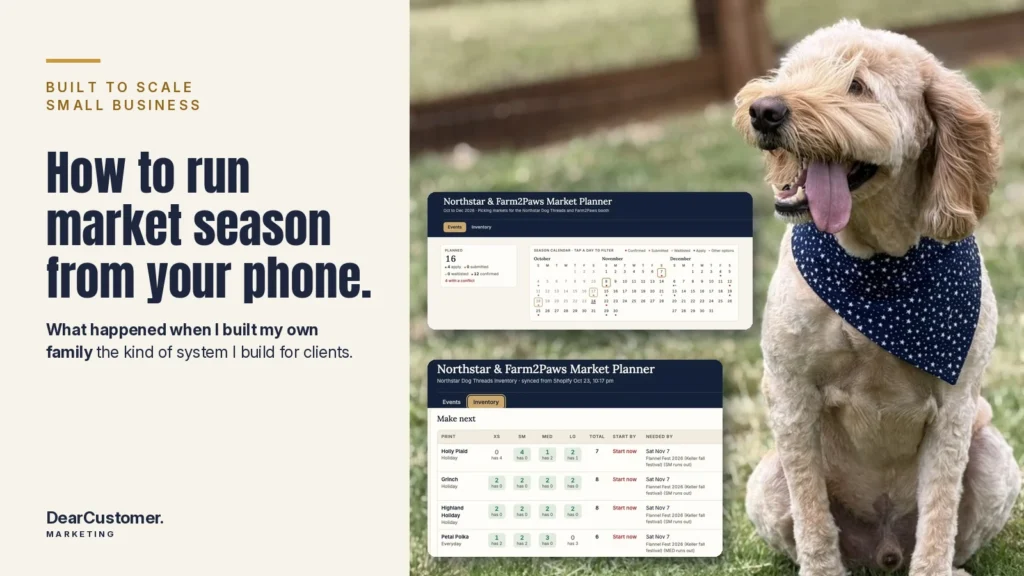
This fall, DearCustomer.Marketing built us a single dashboard, delivered to our phones and desktops. It plans our markets, keeps our inventory in sync with Shopify and tells us what to make next.
Before I walk through it, here’s why I think a lot of families and makers are in the same spot we were.
A Lot of People Sell This Way
We are far from the only ones. Bankrate’s most recent Side Hustle Survey, taken in June 2025, found that 27% of U.S. adults have a side hustle. Online sales is the most popular category, at 15% of side hustlers, and crafts come in at 9%. Parents with kids under 18 are more likely than other adults to have one, at 34%.
Among makers who already sell, ACT Insurance’s 2026 report on artists and crafters found that 85.3% of creative businesses earn more than half their revenue at in-person markets, fairs and festivals. This year, 30.8% are attending more events and 22.9% are growing their online shops. That’s exactly us, with a booth on Saturday and an online store the rest of the week.
The National Retail Federation expects holiday sales in November and December to grow 4.2%, to $1.013 trillion. Holiday market season is when the calendar fills up and stock moves the fastest.
“Where Are We This Weekend?”
Here’s what market season looked like for us before. Everything ran through a group text. Somebody would ask, “Where are we this weekend?” and somebody else would ask, “Who has the setup information?” We checked email to remember whether we had sent an application, and whether we got a spot or landed on the waitlist.
After each market, we sat down to work out what sold and what to make next, and my mother would spread out the inventory to see what she needed to sew. None of it was hard, but the wasted time and inefficiencies added up. And because it lived in a text thread and in everyone’s memory, the answer depended on who you asked.
One Dashboard to Run Our Markets and Online Store
So DearCustomer.Marketing built us one place for all of it. It’s powered by Claude Code and delivered to everyone’s phones and desktops, with two sides: an events dashboard and an inventory dashboard. It’s the same kind of system I build for clients, just pointed at dog bandanas.
The events dashboard
The events dashboard runs scans for new markets that fit our audience profile and adds them to a list for us to consider, each with the link to apply, the booth cost and how many miles it is from home. Right now it’s tracking more than 80 markets between October and December.
It tracks where every application stands, from applied to waitlisted to confirmed, plus the ones we’ve passed on. It keeps a visual calendar with each market’s contact and setup information, so “Who has the setup information?” finally has one answer. At the end of each market, it syncs with our Shopify POS and enters the total sales for that event, so we can track the return on each market we pay for. Over time, that history lets the system make smarter recommendations about which markets to choose.
The inventory dashboard
The inventory dashboard syncs with Shopify POS, which we use at the booth and online, so any of us can see what’s left from our phones. It looks at what we have on hand and which markets are coming up, then lists what to make or order next. It also writes a short summary of how sales are going, suggests offers and bundles, and points out what’s trending.
Bigger businesses are asking for the same thing. In inFlow Inventory’s 2026 survey of 400 operators, 84.8% still track inventory in spreadsheets, and 81% said they want to use AI while only 11% use AI tools in their day-to-day work. When inFlow looked at what its own customers ask for, it was mostly forecasting and reordering, which is our “make next” list.
What Changed for Us
Now everyone has the answers on their phone. Markets and application links show up on the dashboard instead of in a search, and we know exactly what we need to make next. It’s saving us hours every month, and it keeps us from overstocking or understocking. My favorite change is that my mother, who does all of the sewing, no longer has to ask what she needs to sew next. The dashboard gives her the exact prints and sizes based on our upcoming markets and sales history. And I can see the return on every market we pay for.
Before Your Next Market
If you sell at markets, try this before next weekend. Write down every place your market information lives today: the group text, your email, a spreadsheet, somebody’s memory. If that list has more than one line, that’s where your hours are going.
Whether selling at markets is a passion hobby or a business you’re scaling, you owe it to yourself, your family or your staff to stop juggling the chaos. That chaos is tamable now.
If you’d like your markets and inventory in one place, call or text me at 817-623-4188, or book a time at dearcustomer.marketing/book.
Donnine Souhrada is the founder and chief strategist of DearCustomer.Marketing, where she helps founder-led businesses become easier and faster to run, scale, or eventually be ready to sell. Her work connects the systems behind the customer journey, from websites built to be found and recommended in AI search to marketing automation, customer data, and business intelligence dashboards. She cuts down on disconnected tools and manual processes, speeds up customer response to keep the sales pipeline moving, and gets leaders the numbers and next steps they need, delivered to them instead of buried across a dozen apps.
She writes Built to Scale for founders who want to grow without everything depending on them.